
 Kova Center 92G-92H Nguyen Huu Canh Str, Ward 22, Binh Thanh Dist, HCMC
 +84 932 859 976
The Panama Canal: The Backbone of Panama’s Economy and Global Trade
- 26 December, 25
Far more than a maritime shortcut, the Panama Canal is a strategic corridor connecting the Pacific and Atlantic Oceans. It plays a central role in global trade flows while serving as the single most important pillar of Panama’s economy.
By enabling vessels to bypass the lengthy route around South America, the Panama Canal has positioned the country at the crossroads of international commerce. Each year, approximately 5% of global trade and around 22% of global container shipping transit through the Canal. For the United States alone, nearly 40% of containerized trade relies on this route, underscoring its critical strategic importance.
Beyond its global role, the Panama Canal is a powerful economic engine at the national level. Canal operations and related services contribute directly around 2.8%–3% of Panama’s GDP. Indirectly, the broader logistics ecosystem—including ports, warehousing, free trade zones, and multimodal transportation—accounts for more than 30% of GDP. This evolution has enabled Panama to develop into a fully integrated logistics and transit economy, rather than a country dependent solely on canal toll revenues.
Despite being a mature infrastructure asset, the Panama Canal continues to outperform global logistics industry growth. The stable income stream generated by the Canal reduces fiscal volatility and strengthens Panama’s resilience during periods of global economic uncertainty. Between 2020 and 2025, Canal revenue increased from approximately USD 3.44 billion to USD 5.7 billion, representing a compound annual growth rate of about 10.6%. By comparison, global shipping and logistics markets are projected to grow at a significantly slower pace, with an estimated 4.3% CAGR during 2024–2029 and around 6.5% annually through 2033. This contrast highlights the Canal’s strong pricing power and enduring strategic relevance.
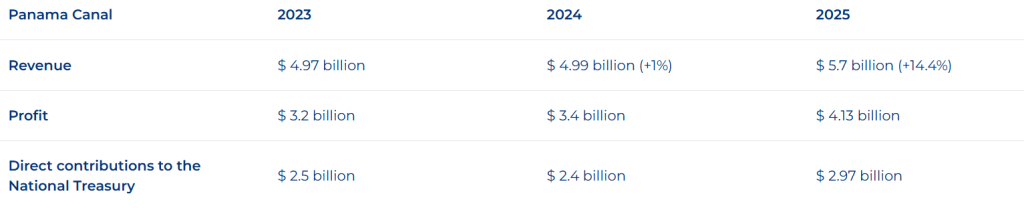
In fiscal year 2025, the Panama Canal reported profits of USD 4.13 billion, while direct contributions to the national treasury reached approximately USD 2.96 billion. Looking ahead to 2026, revenue is projected at USD 5.21 billion, with fiscal contributions expected to increase further, reinforcing Panama’s medium-term economic outlook.
The Panama Canal plays a central role in Panama’s public finances and economic structure. Revenue generated by Canal operations provides a consistent source of income for the national budget, contributing directly to government funding through annual transfers to the National Treasury. This recurring revenue stream supports fiscal planning and reduces reliance on more volatile economic sectors.
Beyond direct fiscal contributions, the Canal anchors a broader logistics and services ecosystem that includes ports, shipping services, warehousing, free trade zones, and multimodal transportation networks. Together, these activities form a significant share of Panama’s economic output and employment base, shaping the country’s role as a regional logistics hub and transit economy.
This article is written by Solaya, powered by Mercan Asia — an insights platform focused on global residency, citizenship-by-investment, and real estate trends. If you’re interested in more insights like this, explore further on SOLAYA ASIA.












 hello@mercan.com