 Kova Center 92G-92H Nguyen Huu Canh Str, Ward 22, Binh Thanh Dist, HCMC
 +84 932 859 976
Greece’s Tourism Industry: From Post-Pandemic Peak to Long-Term Structural Growth
- 9 January, 26
After a powerful rebound from the pandemic shock, Greece’s tourism industry is entering a new phase of development. Recent data shows that while the rapid growth in visitor numbers is gradually slowing, tourism revenue and per-capita spending continue to rise, signaling a structural shift from volume-driven expansion to value-led growth.
2023–2025: From Post-Pandemic Rebound to Mature Expansion
According to official data from the Bank of Greece (BoG) based on non-cruise international arrivals, the period 2023–2025 marks a critical transition for Greece’s tourism sector—from rapid post-pandemic recovery to more stable and sustainable expansion.
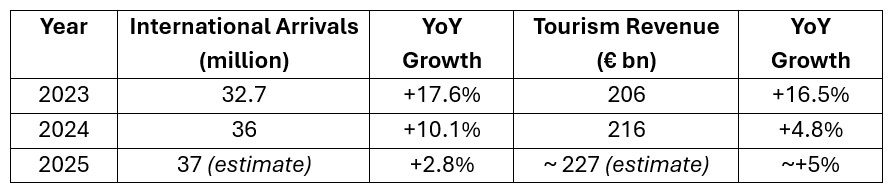
From a phase-based perspective, 2023 marked the completion of Greece’s post-pandemic recovery. In 2024, tourism demand continued to expand, but the pace of growth slowed noticeably, signaling a transition from recovery-driven growth to a more normalized expansion.
The changes observed in 2025 are more structural in nature. As growth in visitor numbers narrowed further, a rebound in per-capita spending led tourism revenue to once again outpace the increase in arrivals. This trend indicates a shift in demand toward higher-spending visitors with longer lengths of stay, with the industry’s growth focus moving from scale expansion to quality enhancement.
Overall, Greece’s tourism sector achieved a compound annual growth rate of approximately 6.3% between 2023 and 2025. More importantly, growth momentum has evolved from short-term post-crisis recovery toward a mature model centered on quality improvement and structural optimization, consistent with the trajectory of established tourism destinations and supportive of long-term sustainability.
2026–2028 Outlook: Momentum Remains, Growth Gradually Moderates
Looking ahead, airline capacity and booking data remain supportive. Flight bookings for the first quarter of 2026 are running approximately 10% above the same period in 2025, while visitor growth in the second half of 2025 remained around 7%, indicating resilient short-term demand.
Against this backdrop, inbound tourism to Greece is expected to maintain low- to mid-single-digit annual growth between 2026 and 2028.
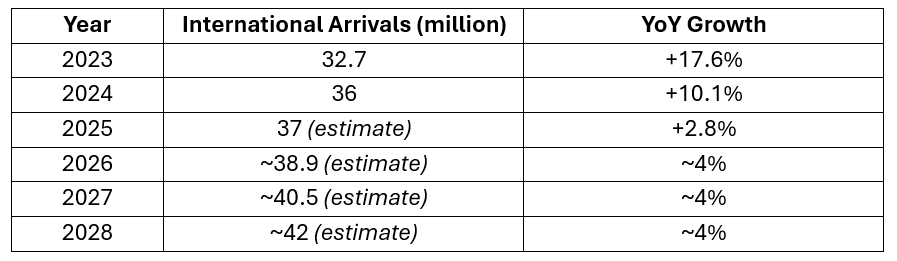
Supported by expanded air capacity, a longer tourism season, and continued growth from non-EU markets, total international arrivals are projected to rise from approximately 38.9 million to nearly 42 million, implying an average annual growth rate of around 4%, with a gradual moderation over time.
Growth during this phase will be driven less by cyclical rebound and more by structural expansion, as traditional European markets stabilize while demand from the United States and other non-EU countries increasingly takes the lead. This transition reflects Greece’s evolution toward a more mature and resilient tourism model.
55 Million Visitors by 2040: A Structural Scenario, Not an Overstatement
The National Bank of Greece (NBG) forecasts that international arrivals could reach approximately 55 million by 2040. This projection is not a simple extrapolation of current growth rates but is based on a global market share framework.
According to the UN World Tourism Organization, global international tourist arrivals are expected to increase from around 1.5 billion today to 2.4 billion by 2040. Currently, Greece holds roughly 5% of the European tourism market, but only about 2.5% of non-European arrivals. If Greece succeeds over the next 15 years in raising its share of non-European visitors to levels comparable with its European market share, the resulting incremental demand could approach 19 million additional visitors, naturally lifting total arrivals toward the 55 million mark.
This growth path is heavily dependent on non-European markets, particularly the United States, Asia, and the Middle East. These travelers tend to be less seasonal, spend more per capita, and align closely with Greece’s strategic shift from high volumes to high value.
Greece’s tourism industry has clearly transitioned into a phase of structural, value-led growth. While visitor numbers are expanding at a slower and more sustainable pace, rising revenues and higher per-capita spending indicate improving quality.
This article is written by Solaya, powered by Mercan Asia — an insights platform focused on global residency, citizenship-by-investment, and real estate trends. If you’re interested in more insights like this, explore further on SOLAYA ASIA.









 hello@mercan.com