
 Kova Center 92G-92H Nguyen Huu Canh Str, Ward 22, Binh Thanh Dist, HCMC
 +84 932 859 976
When Discounts Expand: What Panama’s New Bill Is Really Changing
- 11 May, 26
Panama’s retirement system has been layered over time. For decades, the country has operated with a structured discount framework for retirees — one that effectively creates a parallel cost of living.
This is not a marginal support scheme. It is a pricing structure embedded into the economy. It is also one of the reasons why living costs for retirees remain relatively contained, often between USD 1,200 and 2,000 per month, depending on lifestyle.
What the new bill introduces is not a new system, but an expansion of that logic.
At a surface level, the proposal responds to a familiar pressure: rising living costs. But when placed side by side with the current framework, the shift becomes more visible.
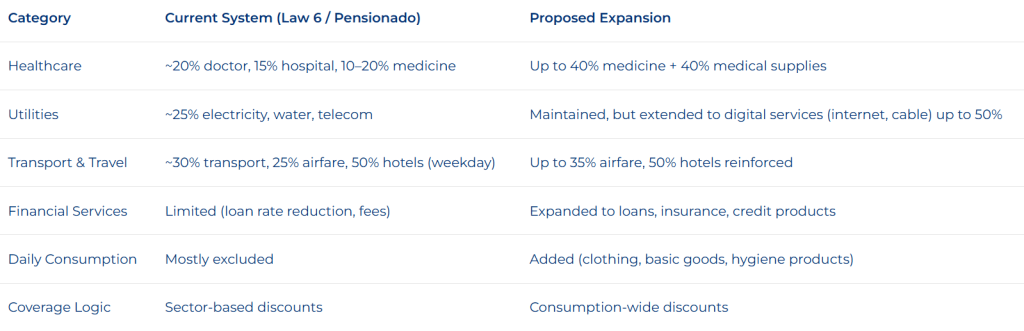
At first glance, the increase from 20% to 40% stands out. But the real shift is not numerical — it is structural. The current system reduces costs in specific sectors such as healthcare, utilities, and mobility. The new proposal extends that logic into everyday spending, moving from targeted relief to broader cost coverage.
This shift points to a deeper issue. Discounts already exist at levels between 10% and 50%, yet a significant number of retirees still operate below the basic cost threshold. The system lowers prices, but not always where spending actually concentrates. The limitation, therefore, is not the level of discount, but its alignment with real consumption patterns.
The new bill attempts to close that gap. By expanding benefits into daily goods and financial access, it brings the system closer to how retirees actually spend. This is less about increasing generosity and more about improving usability — making the framework function in practice, not just in theory.
However, expansion changes the dynamics. Panama’s model relies on private sector participation, where businesses apply discounts upfront and recover them later through tax deductions. The issue is not the existence of discounts, but the timing of compensation. As coverage widens, delays in tax recovery begin to create liquidity pressure, particularly for smaller operators.
This shifts the discussion. It is no longer just about whether benefits should increase, but about how the system absorbs the cost of that increase. In Panama, discounts are not simply incentives — they are part of how demand is sustained within a USD-based, service-driven economy.
That is also why Panama’s Pensionado program has remained one of the most recognized retirement residency programs globally. Beyond permanent residency, retirees gain access to a legally protected discount framework, a U.S. dollar-based economy, relatively low living costs, and no tax on foreign-sourced income. Compared to many retirement destinations, the appeal is not built around one incentive alone, but around the predictability of the overall system.
At the same time, the Pensionado Visa is only one layer of Panama’s broader residency strategy. The country has also positioned itself through programs such as the Qualified Investor Program (QIP), which allows residency through a qualifying investment starting from USD 300,000, as well as the Friendly Nations Visa, aimed at long-term relocation and business integration. Together, these programs reflect a larger economic direction: attracting external capital, internationally mobile investors, and long-term residents into a stable, service-based economy connected to logistics, finance, and global trade flows.
Expanding retiree discounts, therefore, is not only a social adjustment. It is part of a broader recalibration of how Panama positions affordability, residency, and economic participation within the same framework.
And that leads to a more relevant question: not whether retirees should pay less, but how far a discount-driven model can extend before it begins to reshape the balance between public support and private participation.
This article is written by Solaya, powered by Mercan Asia — an insights platform focused on global residency, citizenship-by-investment, and real estate trends. If you’re interested in more insights like this, explore further on SOLAYA ASIA.











 hello@mercan.com